Shadow AI in Sales: Your Reps Are Already Using It — The Only Question Is Whether You Know
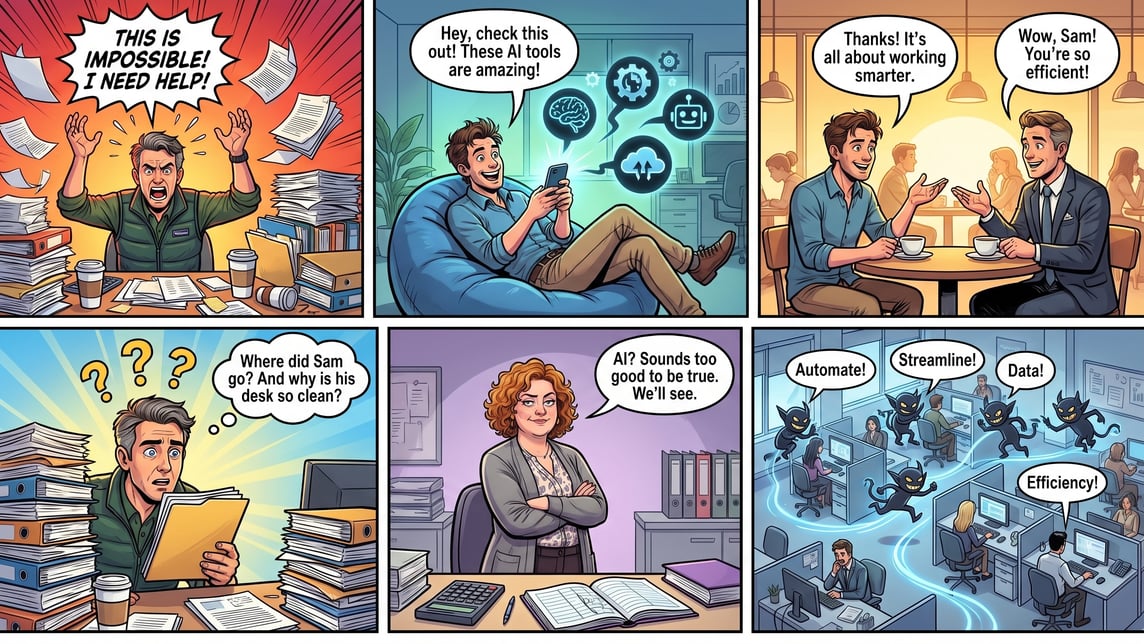
Here is an uncomfortable bet worth making about your sales floor: some of your reps drafted a prospecting email, summarized a discovery call, or researched an account this week using an AI tool your company never approved. They didn't log it. They didn't ask. And if your organization treats that as a fireable offense, they certainly didn't tell you.
This is shadow AI — and pretending it isn't happening is now the single most expensive AI mistake a sales leader can make.
The key insight: shadow AI is not a discipline problem to be stamped out; it is a signal to be read. How you respond determines whether you get a governed, learning organization or a hidden one.
Shadow AI is just shadow IT, evolved
None of this is new in kind. For decades, employees have quietly adopted unsanctioned technology to do their jobs better — the phenomenon researchers call shadow IT. And the evidence is that this behavior is not simply rogue rule-breaking: shadow IT users actively justify their unsanctioned tool use, and those justifications follow recognizable patterns that distinguish users from nonusers (Haag et al., 2019). In other words, reps reaching for ChatGPT aren't being reckless in their own minds — they're solving a real problem the sanctioned toolset didn't solve for them.
That reframing matters because of what shadow IT has been shown to produce. Far from being purely a risk, shadow IT can positively influence innovation within organizations (Silic et al., 2016) — the unofficial workaround is often where the next official process is discovered.
Why bans backfire
The instinct of many sales organizations is to clamp down: prohibit the tools, threaten consequences, treat AI use as a compliance violation. The research on the AI-specific version of this behavior says that instinct is precisely wrong. Shadow AI thrives under punitive social evaluation (Dong et al., 2025) — when people anticipate being judged or penalized for using AI, they don't stop using it; they conceal it. Punishment doesn't reduce the behavior. It reduces your visibility into the behavior, which is the one thing you actually need.
The result of a punitive posture is the worst of both worlds: the AI use continues, the productivity gains accrue invisibly and inconsistently, and the organization loses any ability to govern data handling, verify accuracy, or learn what's working.
The frontline is doing your R&D
There's a more optimistic way to see all this. Emerging theory frames unsanctioned generative-AI use inside firms as shadow user innovation — grassroots experimentation by employees that surfaces genuinely valuable new ways of working before any top-down program would (Waters-Lynch et al., 2024). Your most curious reps are, in effect, running a free, distributed pilot of which AI workflows lift sales productivity. Suppressing it throws away that data.
And the stakes for how you handle it run deeper than tool policy. Generative-AI adoption is linked to real employee outcomes — shaping how people craft their jobs and their commitment to their careers, with the effect moderated by how much employees actually like working with AI (Liu et al., 2025). Handled well, AI adoption can deepen engagement; handled as a threat, it can corrode it.
It's about practice, not policy
The reason official AI policies so often fail to match reality is captured by a foundational idea in technology research: the structures that technology actually creates in an organization emerge through how people use it day to day, not through how it was intended to be used (Orlikowski, 2000). You cannot understand — or govern — AI in your sales team by reading the vendor contract or the acceptable-use memo. You have to look at what reps are really doing with these tools in the flow of a deal.
What sales leaders should actually do
The research points to a clear posture: surface, don't suppress.
- Remove the stigma first. Since shadow AI hides under punitive evaluation (Dong et al., 2025), make honest disclosure safe. You can't govern what reps won't admit they use.
- Treat reps' workarounds as intelligence. Their justifications (Haag et al., 2019) tell you exactly where your sanctioned tools fall short.
- Harvest the innovation. Run structured show-and-tells so shadow user innovation (Waters-Lynch et al., 2024) becomes shared, sanctioned practice instead of private advantage.
- Provide a safe, approved path so the productivity and engagement upside (Liu et al., 2025) is captured with proper data handling — not lost to a ban.
Where this fits in the SalesEvolution system
Shadow AI is the governance edge of everything else in this library. The answer isn't prohibition; it's a sanctioned, well-designed AI capability paired with the judgment to use it responsibly — which is what our work on ethical AI in sales and the dark side of sales technology addresses, and what AI-assisted sales management operationalizes. Turning quiet, individual experimentation into a governed team capability is exactly what our certified business development training and BIZTRAiNING are built to do.
Every claim above links to its peer-reviewed source; browse the full research & sources.
Frequently asked questions
What is shadow AI in sales?
Shadow AI is the use of generative-AI tools — ChatGPT, Claude, Copilot and others — by salespeople without official IT approval or organizational sanction. Reps use them to draft emails, summarize calls, research accounts, and prepare proposals. It is the AI-era successor to 'shadow IT,' the long-documented practice of employees adopting unsanctioned technology to get their work done.
Why is banning AI in sales counterproductive?
Research on shadow AI finds that it thrives under punitive social evaluation — when people fear being judged or penalized for using AI, they hide their use rather than stop it. Bans and stigma don't eliminate the behavior; they push it underground where it can't be governed, supported, or learned from.
Can shadow AI benefit a sales organization?
Yes, if surfaced rather than suppressed. Studies of shadow IT show it can be a genuine source of innovation, and emerging theory frames unsanctioned generative-AI use as 'shadow user innovation' — frontline experimentation that, when harnessed, reveals which tools and workflows actually create value.
The Content Creation Bottleneck: Why B2B Marketing Can't Keep Up With Campaign Speed
Campaigns now demand more channels, more formats, and more personalization than ever — on shorter timelines and flatter budgets. Here's why the traditional content production model breaks under that load, and what actually replaces it.
How to Check What AI Sees About Your Company (And Why SEO Still Matters)
SEO didn't die — but a growing share of buyers now research and brainstorm inside ChatGPT, Claude, Perplexity, and Gemini before they ever open a search bar. Here's a practical, no-tools-required way to check what AI currently sees about your company, and why you need both channels, not one instead of the other.
Put this into practice
See how SalesEvolution applies these methods to your pipeline. Start with a free 30-minute strategy consultation.
Book a strategy consult →