How to Check What AI Sees About Your Company (And Why SEO Still Matters)
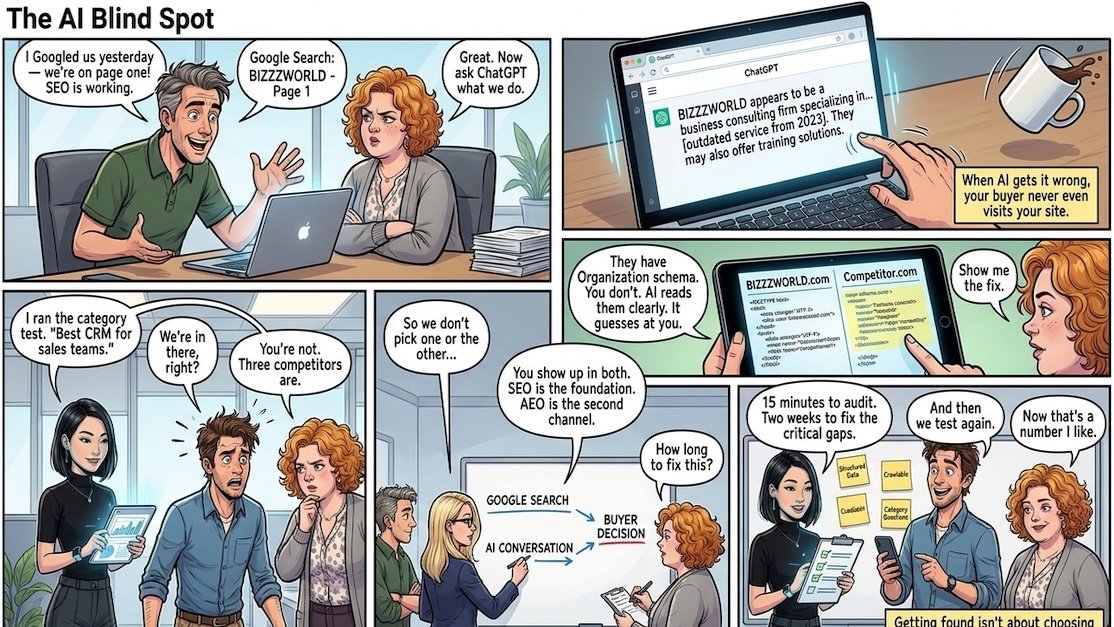
Most buyers still Google you. But a fast-growing share of them start somewhere else entirely: inside a conversation with ChatGPT, Claude, Perplexity, or Gemini, brainstorming and researching before a single query ever hits a search box. That's not a replacement for search — it's a second, parallel channel, and it's now deciding whether you get found before the buyer has even typed your name.
This guide is deliberately practical. No tools, no budget, fifteen minutes: how to check what AI currently sees about your company, and how to think about the SEO-vs-AEO question without treating it as a competition between two budgets.
Search hasn't been replaced — it's split in two
For two decades, "getting found" meant one thing: rank on Google, get the click. That channel hasn't gone away, and it isn't going away — the crawled, indexed web that Google and Bing maintain is still the backbone most AI systems retrieve from when they answer a question. SEO remains the foundation.
What's changed is that a second channel has opened up alongside it. A growing share of research — and, notably, a lot of early-stage brainstorming, the "help me think through this" conversations that used to happen in a dozen open browser tabs — now happens directly inside an AI assistant. The buyer asks a question, gets a synthesized answer naming a handful of options, and forms a shortlist before ever landing on a website. Google's own research on non-linear "messy middle" journeys, Gartner's projections on search volume shifting toward AI and agents, and the steady rise of zero-click answers all point the same direction: buyers increasingly form a view before they visit anyone's site at all.
The important nuance is this: you don't get to choose which channel your buyer uses today. Some still search. Some ask an assistant. Many do both in the same afternoon. Treating this as "SEO vs. AEO" and picking a side is the wrong frame — the right frame is that your company now needs to show up correctly in both, because losing either one is a lost opportunity, not a rounding error.
Three different ways AI can fail you
"AI doesn't see my company" is actually three distinct problems, and the fix is different for each:
- AI can't find you. Your site is technically invisible to AI crawlers — content that only renders after JavaScript runs, a
robots.txtthat unintentionally blocks AI user agents (GPTBot, PerplexityBot, ClaudeBot, Google-Extended), or pages too thin to be worth retrieving. - AI finds you but misunderstands you. The crawler can read your site, but your facts are vague, inconsistent, or scattered — no clear statement of what you do, who you serve, or what makes you different, and no structured data to spell it out unambiguously.
- AI finds and understands you, but recommends someone else. The model has accurate facts about you, but a competitor has stronger trust signals: more consistent third-party mentions, clearer authority, better-structured comparison content.
Each of these needs a different response, which is exactly why "just write more content" is rarely the right fix on its own.
How to check what AI sees about your company right now
This takes about fifteen minutes and needs nothing but the free tier of a few chat assistants.
1. Ask directly, in plain language
Open ChatGPT, Claude, Perplexity, and Gemini and ask each one, separately: "What does [your company name] do?" Read the answer for what's accurate, what's outdated, what's vague, and — the most telling failure — what's simply missing.
2. Ask the category question, not the brand question
This is the test that actually matters, because real buyers rarely type your brand name first. Ask: "Who are the best [your category] providers for [your market]?" or "What tool would you recommend for [the problem you solve]?" If you don't appear, that's the visibility gap that costs you deals — not the brand-question answer, which only tells you what AI knows about people who already know you.
3. Check whether your site is actually crawlable
Look at your robots.txt for any AI-specific user-agent blocks you didn't mean to set. Then check whether the facts that matter — what you do, your pricing, your differentiation — are present in the raw HTML, or only appear after client-side JavaScript runs. Most AI crawlers don't execute JavaScript; content that only exists after a script fires is functionally invisible to them.
4. Check whether your structured data tells a clear story
Organization and FAQPage schema give an AI system your facts in a machine-readable form it doesn't have to infer. If you have none, that's a fast, high-leverage fix — see our full breakdown of Answer Engine Optimization for exactly how to add it.
5. Check what surrounds you, not just what you publish
Search your company name alongside "reviews," "alternative to," and "vs [competitor]." AI systems triangulate trust from multiple independent sources, not just your own site — so an inconsistent LinkedIn profile, an outdated directory listing, or a missing Wikidata entry can quietly undercut an otherwise well-optimized website.
SEO and AEO aren't competing budgets
| SEO | AEO | |
|---|---|---|
| Optimizes for | A ranked link a person clicks | Being the answer itself, extracted and cited |
| Core unit | The page | The self-contained passage |
| Rewards | Backlinks, technical performance, keyword relevance | Question-led structure, entity clarity, structured data |
| Foundation needed | Crawlable, fast, indexed site | The same crawlable, fast, indexed site |
The overlap in that last row is the point: AEO is built on top of solid SEO, not instead of it. A site with weak technical SEO gives AI systems less to retrieve from in the first place, which means neglecting SEO quietly caps how good your AEO can ever be.
The fast way to see this for your own company
Reading about it is one thing; seeing your own results is another. SalesEvolution's free AI Sales Report runs this exact check against your company and your named competitors — what AI currently sees, what it gets wrong, and who gets recommended in your place — and turns it into a report instead of fifteen minutes of manual prompting. If you want the deeper measurement question — why this shift also breaks traditional marketing attribution — we cover that here.
Search didn't disappear. It split. The companies that show up in both halves are the ones still getting chosen either way.
Frequently asked questions
Is SEO still important now that people search and brainstorm with AI?
Yes — SEO is not being replaced, it's being supplemented. Most AI answer engines still retrieve from the same crawled, indexed web that powers traditional search (Google's index and Bing's index in particular), so weak technical SEO quietly undermines your AI visibility too. The practical stance is additive: keep SEO doing its job for the buyers still typing into a search box, and add Answer Engine Optimization (AEO) deliberately for the growing share who go straight to an AI conversation instead.
What's the fastest way to check what AI currently sees about my company?
Open ChatGPT, Claude, Perplexity, and Gemini and ask each one directly what your company does, then ask a category question you'd want to win — like 'who are the best [your category] providers' — without naming your brand. Compare what comes back against reality. For a structured version of the same check, SalesEvolution's free AI Sales Report runs this comparison for you.
Why does ChatGPT get basic facts about my company wrong?
Usually one of three things: the AI system can't crawl your site properly (JavaScript-rendered content, a blocked robots.txt, or thin pages), your site never states your facts clearly and consistently in the first place, or your company is described inconsistently across your site, LinkedIn, and directories, so the model has no single reliable version to trust.
Do I need completely different content for AI search versus Google?
No — the foundations are the same: crawlable, fast, well-structured, authoritative content. What shifts is emphasis. AEO rewards content built around the exact questions buyers ask, with a direct answer up top, short self-contained passages a model can quote cleanly, and structured data (Organization and FAQPage schema) that spells out your facts in machine-readable form.
How often should I recheck what AI sees about my company?
AI models re-crawl the web and update their knowledge on their own schedules, not yours, so treat this like a quarterly check — and always recheck immediately after a site redesign, a rebrand, or a major messaging change, since those are exactly the moments AI visibility quietly breaks.
The Content Creation Bottleneck: Why B2B Marketing Can't Keep Up With Campaign Speed
Campaigns now demand more channels, more formats, and more personalization than ever — on shorter timelines and flatter budgets. Here's why the traditional content production model breaks under that load, and what actually replaces it.
Attribution vs Conversion: Why AI Search Breaks Measurement and Conversion Becomes the North Star
Attribution and conversion are not the same thing, and confusing them leads to misallocated spend and false confidence. As AI search and answer engines mediate the buying journey, attribution breaks by design — and conversion becomes the only verifiable signal left. Here's how to think about it and what to measure instead.
Put this into practice
See how SalesEvolution applies these methods to your pipeline. Start with a free 30-minute strategy consultation.
Book a strategy consult →