Attribution vs Conversion: Why AI Search Breaks Measurement and Conversion Becomes the North Star
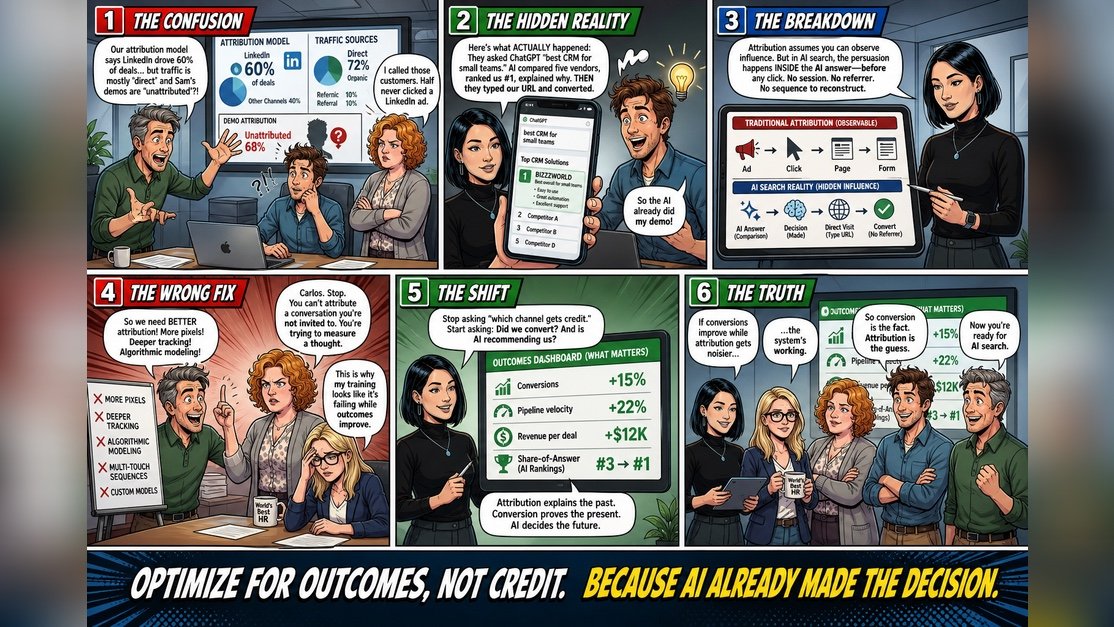
In a lot of marketing conversations, "attribution" and "conversion" get used as if they mean the same thing. They do not — and the gap between them is widening fast. Treat one as the other and you end up over-funding the channels that record deals, starving the ones that create them, and feeling increasingly blind as AI quietly takes over the front of the buying journey.
This guide separates the two terms cleanly, explains why AI search and Answer Engine Optimization (AEO) break the old attribution model, and lays out what to measure instead.
Two terms, two different jobs
A conversion is an outcome. A buyer completes a desired action — submits a form, books a meeting, signs a contract, makes a purchase. It is factual and binary. It happened or it did not.
Attribution is an interpretation. It is the method you use to estimate which marketing efforts influenced that outcome: which channels, which content, in what order, with how much weight. Attribution is not the outcome; it is a model of the cause.
Conversion is a record. Attribution is a theory about that record. Once you hold the two apart, most measurement confusion dissolves.
How modern buying broke the old link
In early digital marketing, the two looked tightly coupled: one ad, one click, one conversion. One channel, one measurable result. That world is gone.
Today's B2B journey is multi-channel, multi-session, multi-device, and multi-stakeholder — and increasingly mediated by AI before a human ever clicks. A single conversion can be shaped by an AI search summary, peer content, paid ads, organic search, a sales conversation, social proof, and an offline hallway chat. Attribution tries to reconstruct that tangle after the fact. Conversion simply records where it ended.
That is also why attribution is fundamentally harder than conversion. A conversion is binary. Attribution is probabilistic — it has to answer which touchpoints mattered most, which accelerated trust, which reduced friction, and which merely happened to be nearby. That is why attribution models exist, and why they disagree.
The limits of the classic models
- Last-click assigns 100% of the credit to the final interaction. Easy to measure, badly misleading — it ignores everything that made the buyer ready to act.
- First-click assigns it all to the first interaction. Useful for awareness, blind to nurture, validation, and the sales work that actually closes.
- Multi-touch (MTA) spreads credit across touchpoints and acknowledges that influence accumulates. Closer to reality, still imperfect.
- Algorithmic / data-driven uses statistical modeling to weight touchpoints by observed impact and adapts as behavior changes. It is the most honest of the four — and it openly treats attribution as an estimate, not a fact.
Every one of these assumes the same thing: that influence is observable, trackable, and reconstructable from clicks, sessions, and referrers. AI search invalidates that assumption.
Why AI search breaks attribution — by design
1. AI becomes the intermediary. In AI search, buyers don't interact directly with your ads, pages, and forms. They interact with an AI-generated answer that has already read your content and your competitors', synthesized a view, and made a recommendation. There is no click, no session, no referrer to attribute. The influence lands before the measurable event.
2. AEO operates upstream of observation. Answer Engine Optimization shapes how AI describes, compares, and recommends you — often without requiring a visit at all. By the time a conversion happens, the persuasion already occurred off-platform, where your analytics can't see it.
3. The funnel collapses. Awareness, education, comparison, and shortlisting increasingly happen inside a single AI interaction. There is no clean sequence to reconstruct — only decision readiness at the moment of conversion. Attribution science depends on sequence. AI removes the sequence.
The instinct to respond with "we need better attribution models" misreads the problem. The issue isn't the model; it's the premise. You cannot attribute a summary you never saw, a comparison you didn't host, or a recommendation you didn't deliver. Trying to attribute non-observable influence is like trying to attribute a thought.
Why conversion becomes the north star
In an AI-mediated and increasingly agentic market, conversion becomes the ground truth — not as a vanity metric, but as a system outcome:
- In AI commerce, agents will compare vendors, apply filters, optimize for buyer preferences, and execute purchases. Channel attribution becomes meaningless; the only question that matters is did the AI choose us.
- In B2B AI pipelines, AI pre-qualifies buyers, filters vendors, and shapes shortlists. Sales sees fewer leads, higher intent, and faster decisions. Attribution looks worse while the business gets better — that's the new model working, not a bug.
So the question shifts from "which channel drove this click?" to "did the buyer convert, and is AI putting us in the consideration set?"
What to measure instead
Stop optimizing primarily for click paths, channel credit, and attribution precision. Start optimizing for:
- Conversion efficiency — the verifiable outcome, treated as the system's success signal.
- Pipeline velocity — how fast qualified opportunities move.
- Revenue per opportunity — quality over raw volume, since AI is filtering for you.
- Share-of-Answer — how often AI assistants name or recommend you for priority buyer questions, versus competitors. This is the visibility layer attribution cannot capture.
- Decision-stage clarity — whether your content resolves the specific question a buyer (or their AI) is asking at each stage.
The mindset is simple: attribution explains the past, conversion proves the present, and AI increasingly decides the future. If conversion improves while attribution gets noisier, the system is working. If conversion stalls, AI is probably choosing someone else — and that is the signal worth acting on.
The practical takeaway
You don't have to throw attribution away. You have to demote it. Use it where the journey is still observable, as a directional input — not as the scoreboard. Make conversion and Share-of-Answer your primary measures, invest earlier in the buyer journey where AI now forms its view, and judge marketing by whether it accelerates real outcomes rather than by which click it can take credit for.
Industry signals point the same way: Google's "messy middle" research on non-linear journeys, Gartner's projections on the shift of search volume to AI and agents, and the steady rise of zero-click discovery all describe the same reality from different angles. The dashboards that survive the next few years will be the ones built around verifiable outcomes — because in an AI-mediated market, conversion is the truth and attribution is, at best, a well-informed guess.
Frequently asked questions
What is the difference between attribution and conversion?
A conversion is an outcome a buyer completes — a form submission, a booked meeting, a signed contract. It is factual and binary: it either happened or it did not. Attribution is the methodology used to estimate which marketing efforts influenced that outcome — which channels, which content, in what sequence, with what weight. Conversion is what happened; attribution is a probabilistic explanation of why.
Why does AI search break traditional attribution?
Attribution models assume influence can be observed, tracked, and reconstructed from clicks, sessions, and referrers. In AI search, much of the persuasion happens inside an AI-generated answer — before any click. There is often no session and no referrer to attribute, and the funnel collapses into a single interaction, so there is no clean sequence to reconstruct. The influence is non-observable by design.
What is AEO (Answer Engine Optimization)?
Answer Engine Optimization is the practice of structuring your content and brand signals so AI systems — ChatGPT, Perplexity, Google AI Overviews, Copilot — interpret you accurately and recommend you when buyers ask questions. AEO operates upstream of the measurable click: it shapes the decision before a visit ever happens.
Does this mean attribution is dead?
No. Attribution still has value for the parts of the journey that remain observable, and as a directional input. But it can no longer be the primary metric. Treating an estimate of influence as if it were the outcome leads to over-funding channels that merely record conversions and cutting the ones that quietly built the decision.
What should marketers track instead of attribution in AI search?
Track verifiable outcomes and leading indicators of decision readiness: conversion efficiency, pipeline velocity, revenue per opportunity, and Share-of-Answer — how often AI systems mention or recommend you for the questions that matter. The shift is from 'which channel drove this click' to 'did AI choose us, and did the buyer convert.'
What is Share-of-Answer?
Share-of-Answer measures how frequently AI assistants name or recommend your brand for a defined set of priority buyer questions, relative to competitors. It is the visibility layer that classic attribution cannot capture, because it happens inside the answer rather than on your site.
The Content Creation Bottleneck: Why B2B Marketing Can't Keep Up With Campaign Speed
Campaigns now demand more channels, more formats, and more personalization than ever — on shorter timelines and flatter budgets. Here's why the traditional content production model breaks under that load, and what actually replaces it.
How to Check What AI Sees About Your Company (And Why SEO Still Matters)
SEO didn't die — but a growing share of buyers now research and brainstorm inside ChatGPT, Claude, Perplexity, and Gemini before they ever open a search bar. Here's a practical, no-tools-required way to check what AI currently sees about your company, and why you need both channels, not one instead of the other.
Put this into practice
See how SalesEvolution applies these methods to your pipeline. Start with a free 30-minute strategy consultation.
Book a strategy consult →