The Content Creation Bottleneck: Why B2B Marketing Can't Keep Up With Campaign Speed
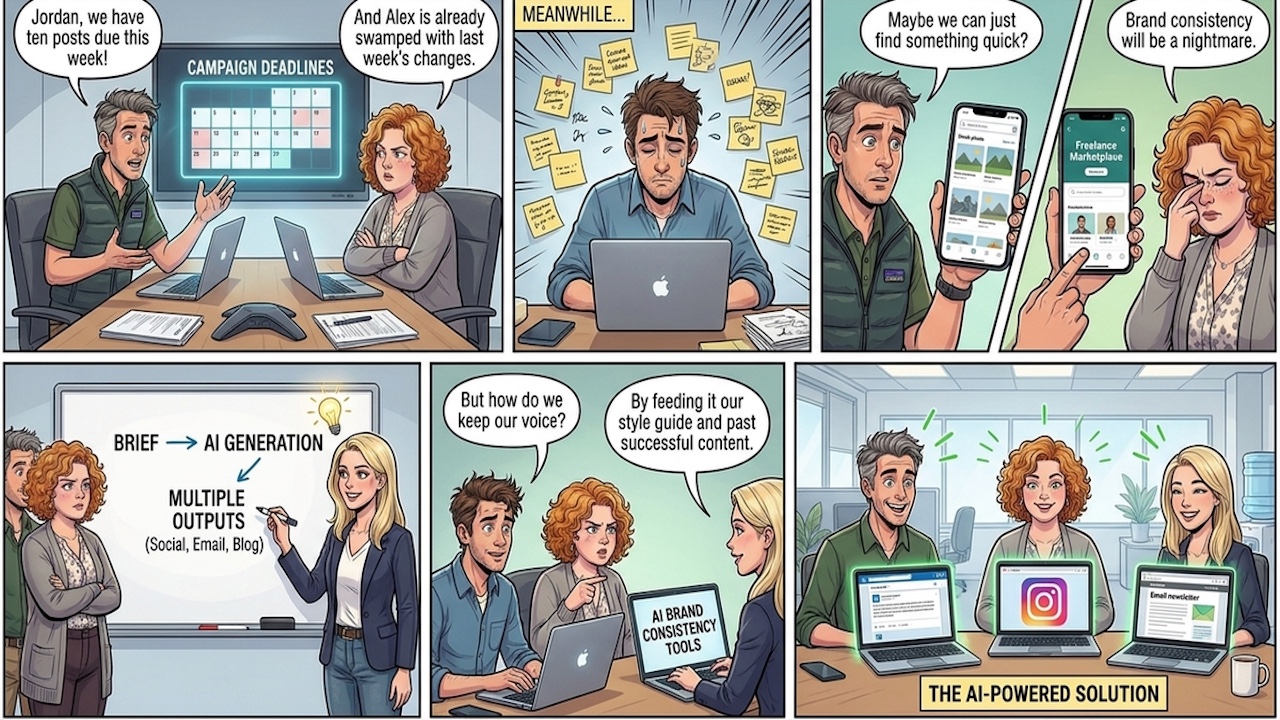
A single B2B campaign used to need a handful of assets: a hero image, an ad banner, maybe a one-pager. Today the same campaign needs a LinkedIn post, an Instagram square, a Story or Reel, a blog header, an email banner, and a handful of ad variants — each a different size, several needing different messaging for different segments. The number of formats multiplied. The size of the creative team did not.
The core problem: content demand scaled with the number of channels and the speed of campaigns. Content production didn't.
The math stopped working
Traditional content production was built around a small number of high-effort, high-polish assets: a photoshoot, an edited video, a handful of hero images repurposed everywhere. That model assumes time — time to brief a designer, time for a revision cycle, time to schedule a video shoot. Modern campaigns don't have that time. A competitor announcement, a trending topic, or a fast-moving deal can demand new creative within hours, not weeks, and it needs to exist in six different aspect ratios before lunch.
Five pressures the old model wasn't built for
- Format explosion. LinkedIn, Instagram feed, Instagram Story, Reels, blog headers, email, display ads — each platform has its own dimensions, and a single "hero image" doesn't survive being stretched or cropped into all of them without looking wrong.
- Compressed timelines. Campaigns that used to run for a quarter now iterate weekly. Creative has to keep pace with the calendar, not the other way around.
- Personalization at scale. Every segment, region, or account tier increasingly expects tailored messaging — multiplying the number of asset variants needed for what used to be one campaign.
- Budget scrutiny. Marketing spend gets measured more tightly than ever; a fixed monthly design retainer is hard to justify when campaign volume swings week to week.
- Brand consistency across contributors. As more freelancers, agencies, and internal reps produce content, keeping tone, palette, and quality consistent gets harder, not easier.
Why the usual fixes fall short
Three common responses to the bottleneck each solve part of the problem and leave the rest untouched.
Stock photography is instant and cheap, but generic by definition — it can't show your product, your brand's specific aesthetic, or a message built for this campaign. Audiences increasingly recognize and discount stock imagery on sight.
Hiring or outsourcing more design capacity produces genuinely custom work, but cost scales linearly with volume: twice the assets means roughly twice the spend, and a slow campaign month still carries the same fixed cost as a heavy one. It also doesn't fix the format-explosion problem — a designer still has to manually resize and re-crop each asset for every platform.
Do-it-yourself design tools speed up manual resizing and templating, but a human still has to operate them for every single asset, and they don't generate genuinely new images, video, or copy — only rearrange what's already there.
None of the three fixes the actual constraint: producing net-new, on-brand creative, in every format a campaign needs, at the speed campaigns now move.
What an AI content studio changes
The shift is treating image, video, and copy generation as a single, on-demand studio rather than three separate production pipelines. A single prompt generates a piece of creative once, then exports it correctly cropped for every platform size selected — LinkedIn, Instagram, Story, blog header, or custom pixels — in one run, instead of a designer manually resizing it five times. Short video clips with sound generate directly from a brief instead of a shoot and edit cycle. Copy in a set tone, length, and language drafts alongside the visuals rather than in a separate workflow. Brand style presets — a saved mood, palette, and "avoid" list — keep every generation on-brand without a creative director reviewing each individual asset. And because generation is billed per piece rather than by monthly seat, cost tracks actual campaign volume instead of a fixed retainer.
A practical rule of thumb
Let AI absorb the volume and the variations — the ten sizes, the five headline options, the quick 8-second clip — and keep human judgment on the brand standard and the final call. The goal isn't fewer people making creative decisions; it's fewer hours spent on the repetitive part of production so campaigns can move at the speed the market actually demands.
Where this fits in the SalesEvolution system
This is exactly the gap BizArtworks is built to close — one workspace for AI image, video, and copy generation, with multi-size export, brand presets, and per-project cost tracking, billed pay-as-you-go instead of by monthly seat. It sits alongside generative AI for sales content as the other half of the content equation: that guide covers AI-drafted outreach and collateral text; this one covers the visual and video production that text increasingly needs to ship with. If your content is well-produced but still isn't being found, pair it with Answer Engine Optimization or start with a free AI visibility report.
Frequently asked questions
Why is content creation a bottleneck for B2B marketing teams?
Campaigns now need distinct assets for every channel — LinkedIn, Instagram, Stories, blog headers, ads, email — each in a different size and format, often for multiple audience segments at once. Design and video teams grew to handle a handful of channels at a slower pace; they haven't scaled to match the number of formats or the speed campaigns now demand. The result is a queue: marketing waits days for assets that a fast-moving campaign needed yesterday.
Why don't stock libraries or freelancers solve the problem?
Stock photography is fast but generic — it doesn't reflect your product, your brand, or your specific campaign message, and audiences increasingly recognize and discount it. Freelancers and agencies produce genuinely custom work, but each new asset restarts the brief-review-revise cycle, and cost scales linearly with volume. Neither approach fixes the underlying problem: content demand grew faster than the production model built to meet it.
Does AI-generated content replace designers and video teams?
Not entirely — it replaces the repetitive, high-volume part of the job: resizing one visual into ten platform formats, producing a first-pass video clip, drafting the fifteenth variation of an ad headline. Human creative direction still sets the brand's mood, palette, and standards; AI executes inside those guardrails at a pace and cost no manual workflow can match.
How does pay-as-you-go AI content pricing compare to hiring or subscriptions?
A monthly design subscription or freelance retainer costs the same whether a campaign needs five assets or fifty that month. Pay-as-you-go pricing — a wallet you top up, billed per generation — scales directly with actual output: heavy campaign weeks cost more, quiet weeks cost less, and there's no idle capacity to justify.
How to Check What AI Sees About Your Company (And Why SEO Still Matters)
SEO didn't die — but a growing share of buyers now research and brainstorm inside ChatGPT, Claude, Perplexity, and Gemini before they ever open a search bar. Here's a practical, no-tools-required way to check what AI currently sees about your company, and why you need both channels, not one instead of the other.
Attribution vs Conversion: Why AI Search Breaks Measurement and Conversion Becomes the North Star
Attribution and conversion are not the same thing, and confusing them leads to misallocated spend and false confidence. As AI search and answer engines mediate the buying journey, attribution breaks by design — and conversion becomes the only verifiable signal left. Here's how to think about it and what to measure instead.
Put this into practice
See how SalesEvolution applies these methods to your pipeline. Start with a free 30-minute strategy consultation.
Book a strategy consult →